For many ecommerce brands, the online store is only one part of the business.
As the brand grows, it often needs to manage more than direct-to-consumer sales. There may be wholesale buyers, retail partners, ambassadors, influencers, distributors, clinics, salons, professional customers or B2B accounts that need access to specific information, materials, offers or ordering flows.
A standard customer account page is usually not enough for that.
It can show order history, saved addresses and basic account details, but it does not support the more complex relationship between a brand and its partners.
That is where a custom partner portal becomes valuable.
A partner portal gives selected users a dedicated space where they can access resources, place orders, download materials, review product information, manage requests or interact with the brand in a more structured way.
At Nethype, we design and develop custom partner portals for ecommerce brands that need more than a standard storefront or basic customer account area.
If your ecommerce brand needs a custom partner portal, B2B dashboard or private partner experience, contact us at info@nethype.co
A partner portal is a private digital space created for specific groups connected to your brand.
Depending on the business model, this can include:
Instead of sending files, links, price lists, campaign materials or order instructions manually, the brand can give partners one central place to access everything they need.
A partner portal can be connected to the ecommerce store, built as a custom Shopify experience, or designed as a separate branded platform that supports the store’s wider business operations.
For partners, it creates clarity.
For the brand, it reduces repetitive communication, improves control and makes collaboration easier to scale.
A partner portal becomes useful when communication with partners starts to feel scattered, manual or difficult to manage.
For example, your team may be sending the same assets by email, manually sharing product documents, managing partner requests in spreadsheets, or creating different order flows for different types of buyers.
At some point, this becomes inefficient.
You may need a custom partner portal if:
The goal is not just to create a login area.
The goal is to build a clear digital experience that supports the way your brand actually works with partners.
If your current partner process depends too much on manual emails, shared folders or spreadsheets, contact us at info@nethype.co
Most ecommerce platforms offer some version of a customer account.
A standard account page usually includes:
This is useful for regular customers, but it is rarely enough for partners.
Partners often need more context, more tools and more access.
A custom partner portal can include:
In other words, a standard customer account is built around past purchases.
A partner portal is built around an ongoing business relationship.
That difference matters, especially when partners play an important role in sales, marketing, distribution or brand growth.
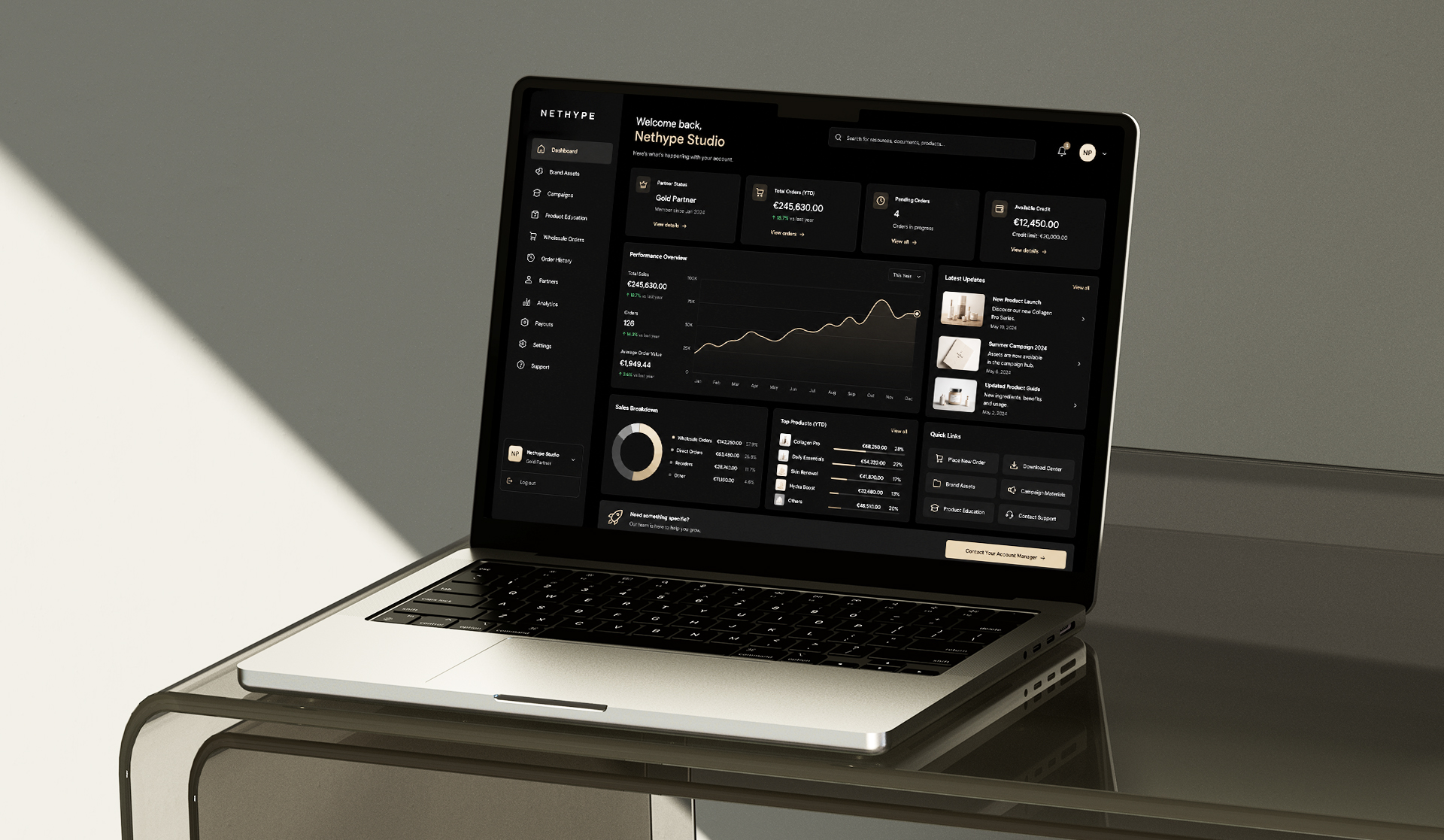
At Nethype, we have designed and developed a custom partner portal for Bodicine, a beauty and wellness brand offering collagen-based products.
The goal was to create a dedicated digital space for the brand’s partners, making it easier to access key materials, product information and partner-specific resources in one place.
Projects like this show why a partner portal is more than just a login area. It can become a practical part of the brand’s ecommerce ecosystem, supporting communication, education and collaboration with selected users.
For brands like Bodicine, a custom partner portal can help organize:
Instead of managing everything through emails, shared folders or manual messages, the brand can give partners a clear and branded place to find what they need.
For the internal team, this means fewer repetitive questions, better control over shared materials and a more scalable way to manage partner relationships.
For partners, it means a smoother experience and easier access to the information that helps them represent the brand properly.
This is where custom ecommerce development becomes especially valuable. The portal can be designed around the actual relationship between the brand and its partners, instead of forcing the business into a generic tool.
If your ecommerce brand needs a similar partner portal, contact us at info@nethype.co
A custom partner portal can be designed around your exact business model.
For one brand, it may be a simple resource hub for ambassadors. For another, it may be a full B2B ordering dashboard with custom pricing, product education and partner-specific content.
Below are some common features we can design and develop for ecommerce brands.
A partner dashboard gives users a clear starting point after logging in.
It can show the most important information in one place, such as:
The dashboard should be simple, useful and tailored to the type of partner using it.
A retail partner may need product sheets and wholesale ordering.
An ambassador may need campaign links, discount codes and content guidelines.
A professional customer may need education materials, exclusive products or recurring order options.
A custom dashboard allows each user group to see what is relevant to them.
Not every partner should see the same content.
A custom partner portal can include different levels of access depending on the user role.
For example:
Role-based access helps the brand keep information organized and controlled.
It also creates a better user experience, because partners are not overwhelmed with content that does not apply to them.
For ecommerce brands selling wholesale, the partner portal can include a private B2B product catalogue.
This catalogue may be different from the public store.
It can include:
A B2B catalogue can make ordering easier for partners and reduce the amount of manual communication needed from the sales team.
Instead of sending PDFs, spreadsheets or email instructions, the brand can create a structured buying experience inside the portal.
If your brand needs a custom B2B catalogue or wholesale ordering experience, contact us at info@nethype.co
Some partners do not need a traditional product browsing experience.
They need a fast way to place larger or repeat orders.
A custom partner portal can include wholesale order forms designed for speed and clarity.
This can include:
This is especially useful for brands where B2B partners already know what they want and need a faster way to order.
A good wholesale form can save time for both the partner and the internal team.
Many brands work with partners who need access to visual and marketing materials.
A partner portal can become a central library for brand assets.
This may include:
Instead of sending files manually or maintaining separate folders, the brand can give partners a clean, branded place to find the latest materials.
This also helps maintain consistency.
Partners use approved assets, updated product information and correct brand messaging.
For brands working with ambassadors, influencers or creators, a partner portal can make campaign management easier.
The portal can include:
This gives creators a better experience and helps the brand reduce confusion.
Instead of sending instructions across multiple emails or messages, everything can live in one place.
For ambassador-led brands, this can become a very important part of the marketing system.
Some products require explanation.
This is common in industries such as beauty, supplements, wellness, healthcare, furniture, design, home improvement, technology and B2B ecommerce.
A custom partner portal can include education materials such as:
This helps partners understand the product better and sell or represent it more confidently.
It can also reduce repetitive questions sent to the brand’s support or sales team.
If your brand works with ambassadors, affiliates or referral partners, the portal can include tools that support performance tracking and campaign activity.
Depending on the setup, this may include:
Not every brand needs a full affiliate system.
Sometimes, the best solution is a simple custom dashboard that shows the right information in a clear and branded way.
A portal can be designed around the level of complexity that makes sense for the brand.
A partner portal can also support onboarding.
Instead of sending new partners a long email with scattered links and instructions, the brand can create a structured onboarding flow.
This can include:
A good onboarding experience helps partners become active faster.
It also makes the brand feel more professional and organized from the beginning of the relationship.
If you want to turn partner onboarding into a cleaner digital experience, contact us at info@nethype.co
There are many tools that can support parts of a partner program.
There are apps for wholesale pricing, affiliate tracking, file sharing, gated content and customer accounts.
For simple use cases, these tools can be enough.
But when a brand needs a portal that combines business logic, branded design, multiple user roles, custom ordering flows and ecommerce integration, ready-made tools often become limiting.
Common limitations include:
Custom development allows the portal to be designed around the way your brand actually works.
It can connect to your ecommerce setup, support your operational process and create a partner experience that feels like a natural extension of your brand.
A partner portal should not feel like a random login area.
It should feel like a professional, useful and branded environment built for the people who help your brand grow.
A custom partner portal can be connected to Shopify in different ways depending on the use case.
It may use:
The right setup depends on what the portal needs to do.
For example, a wholesale portal may need partner-specific pricing and bulk ordering. An ambassador portal may need campaign assets and referral links. A professional customer portal may need education materials, exclusive products and account-specific documents.
Before building the portal, it is important to define:
A good partner portal should be useful for partners and manageable for the internal team.
A partner portal can support many types of ecommerce brands and business models.
For clinics, salons, therapists, ambassadors, professionals or retail partners who need product education, campaign materials, ordering tools or exclusive resources.
For retailers, stylists, ambassadors, showrooms or wholesale buyers who need lookbooks, line sheets, collection assets, product information and B2B ordering.
For ambassadors, professionals, distributors or clinics that need education content, product guidelines, referral tools and partner-specific materials.
For retail partners, stockists, stylists or B2B buyers who need catalogues, product sheets, campaign assets, wholesale pricing and ordering tools.
For interior designers, architects, retailers or trade partners who need product specifications, fabric samples, configuration tools, catalogues and trade pricing.
For business customers who need custom catalogues, repeat ordering, saved order templates, quotes, documents and account-specific resources.
A well-designed partner portal can improve both the partner experience and the internal workflow of the brand.
Key benefits include:
Partners can access resources, documents and information without asking the team every time.
A clear dashboard makes it easier for partners to understand what they can do and where to find what they need.
Partners use approved, updated and consistent materials.
Wholesale or business customers can place orders in a structured way instead of relying on emails or spreadsheets.
New partners can go through a clear onboarding process without confusion.
As the number of partners grows, the brand does not need to manually repeat the same process for every person.
A professional portal makes the brand feel more organized, premium and easier to work with.
A custom partner portal is worth considering when partners play an important role in your business.
You may need one if:
For simple stores, a standard customer account may be enough.
But for brands with B2B, wholesale, ambassador or partner programs, a dedicated portal can become an important part of the ecommerce infrastructure.
If you are not sure whether your brand needs a custom partner portal, contact us at info@nethype.co - we can help you define the right structure and technical approach.
At Nethype, we approach partner portals from both a design and development perspective.
We do not only ask:
“What should partners see after logging in?”
We also ask:
A strong partner portal is a mix of UX strategy, interface design, ecommerce logic and custom development.
The result should feel simple for partners, even if the system behind it supports multiple roles, resources, ordering flows and integrations.
As ecommerce brands grow, their digital needs often go beyond the storefront.
Selling products is only one part of the system. Managing partners, B2B buyers, ambassadors, retailers, distributors and professionals can become just as important.
A custom partner portal helps bring those relationships into one clear digital space.
It can reduce manual communication, improve partner onboarding, organize brand assets, support B2B ordering and create a more professional experience for the people working with your brand.
A good partner portal does more than hide content behind a login.
It helps your partners understand your brand, access the right tools and work with you more efficiently.
Nethype designs and develops custom partner portals for ecommerce brands that need more than a standard customer account page.
Whether you need a B2B portal, wholesale dashboard, ambassador hub, resource library, gated content experience, custom order flow or Shopify-connected partner platform, we can help you create a solution tailored to your business model.
Contact us at info@nethype.co and let’s build a partner portal that makes your ecommerce operations easier to scale.