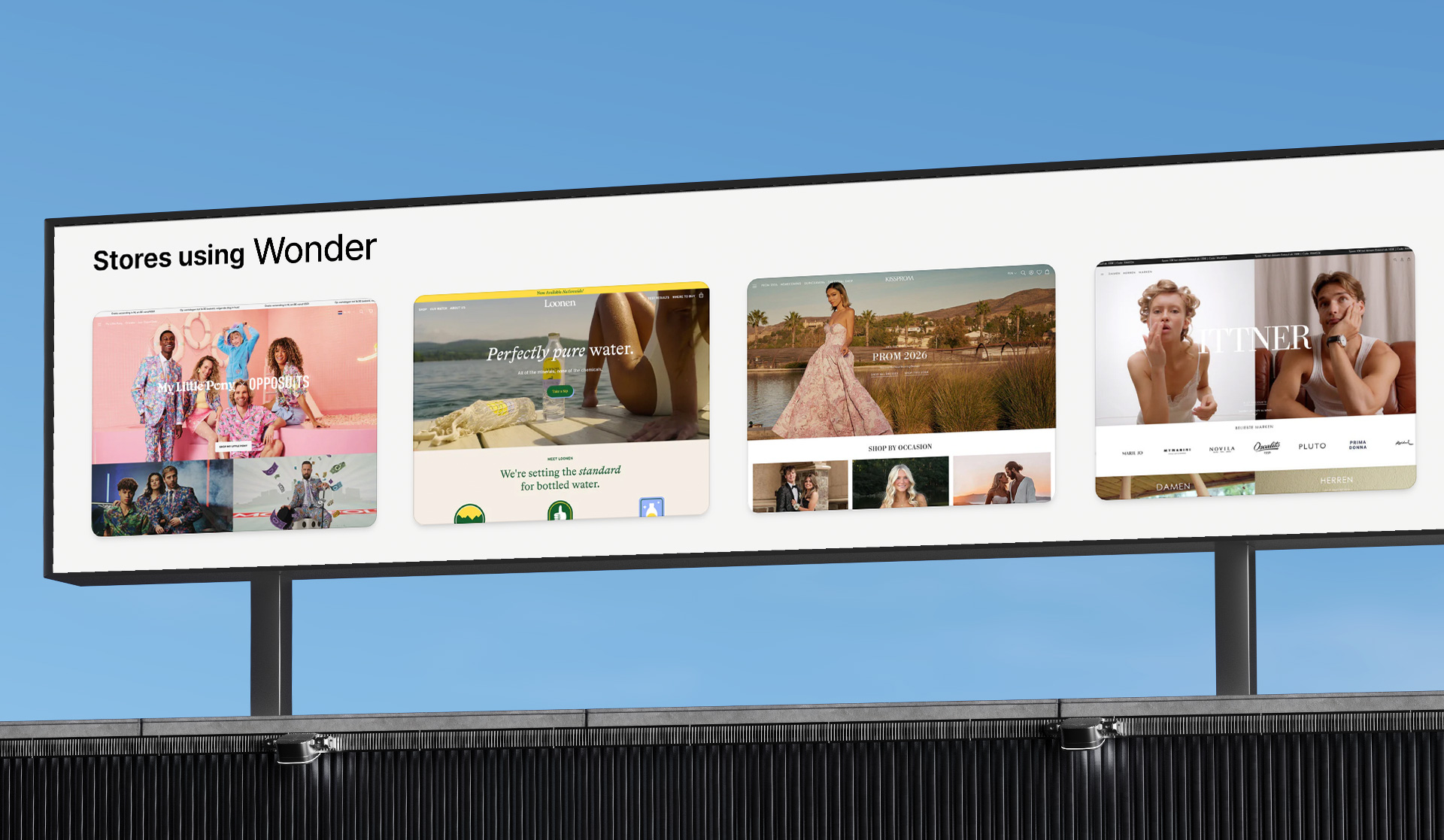
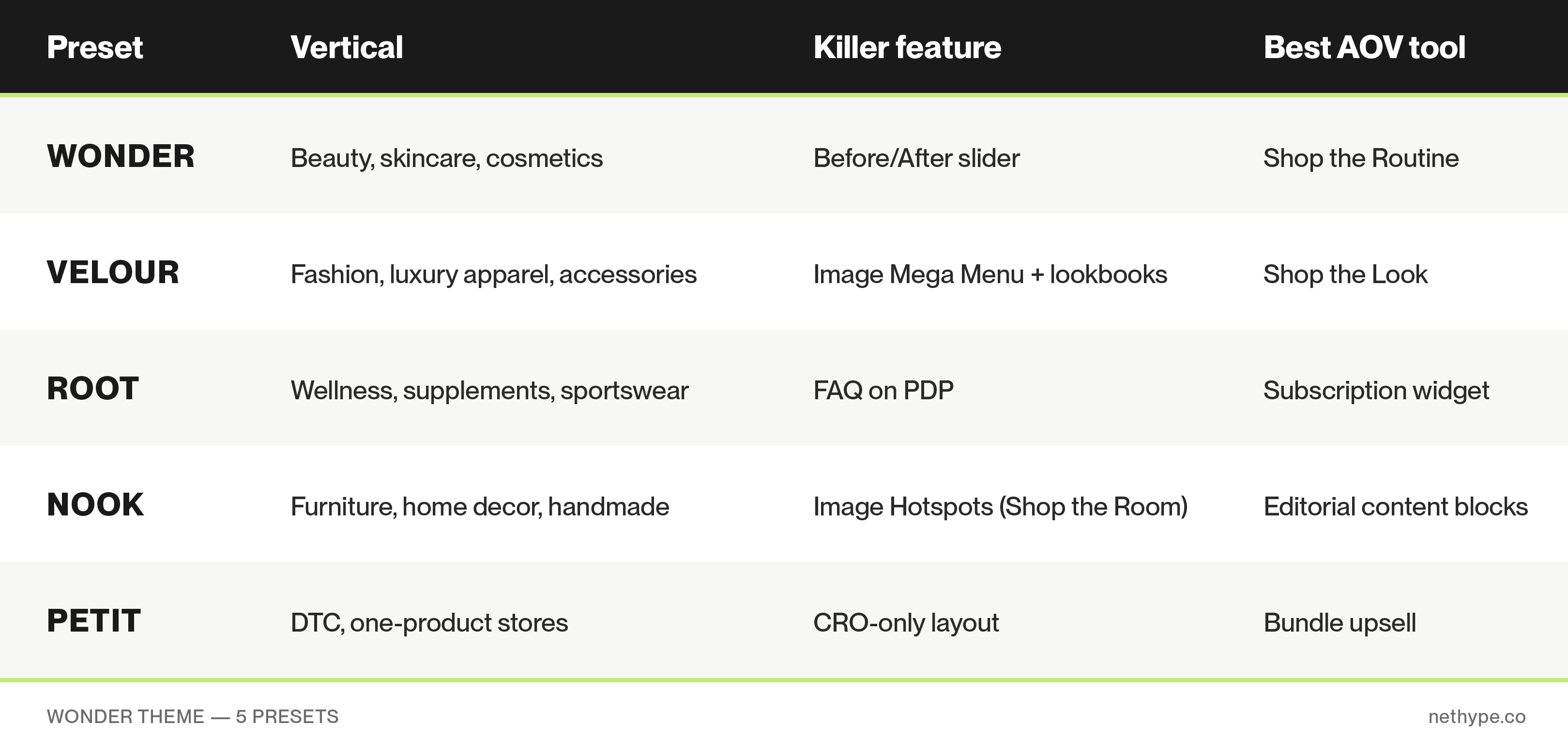
Wonder Theme comes with 5 presets in the official Shopify Theme Store, each tailored to a specific vertical: WONDER for beauty and skincare, VELOUR for fashion and luxury apparel, ROOT for wellness and supplements, NOOK for furniture and home decor, and PETIT for one-product DTC stores. They all share the same technical foundation - Shoppable Video, mobile-first design, EU translations, and Core Web Vitals optimized from the ground up. What changes is the visual identity, layout structure, and vertical-specific functionality.
This article is your complete guide to picking the right one. We start with a decision tree (the fastest way), follow up with a comparison table, then dive deep into each preset with the customer archetypes it fits best.
If you only have a minute, here's the fast track. Find the description that matches your brand:
→ You sell skincare, makeup, fragrances, or beauty devices
Pick WONDER It's built around Before/After sliders (because beauty buyers need proof) and "Shop the Routine" sections (because beauty AOV grows when products are sold in context, not in isolation).
→ You sell apparel, handbags, shoes, jewelry, or watches
Pick VELOUR Editorial layout, image-rich Mega Menu with lookbooks, "Shop the Look" for complete outfits. Built for premium fashion brands where browsing is part of the experience.
→ You sell supplements, sportswear, sport equipment, or anything wellness/longevity
Pick ROOT FAQ on every product page (kills objections before checkout), built-in subscription widget (lifts LTV), ingredient accordions for full transparency. Works equally for nutraceuticals, sportswear, and bike retailers.
→ You sell furniture, home decor, ceramics, candles, or handmade goods
Pick NOOK Image Hotspots ("Shop the Room") let customers click on any element of a room photo to buy it. Editorial content blocks for lifestyle-driven brands.
→ You sell ONE flagship product - beauty device, supplement, gadget, hero launch
Pick PETIT CRO-only layout with no distracting navigation. Built around one CTA: purchase. Perfect for LED face masks, NAD+ pens, peptide brands, or any single-SKU launch.
→ Still not sure?
Read the comparison table and deep dives below. If you're still unsure after that, the fastest path is to book a free consultation - info@nethype.co - 60 minutes with us, no commitment, and we'll tell you which preset fits your business.
All 5 presets share the same technical foundation. What differs is the visual identity, layout, and vertical-specific functionality. Here's the side-by-side:
Shared across all 5 presets:
License price: $390 one-time in the Shopify Theme Store.
Best for: brands selling skincare, makeup, fragrances, beauty devices, hair care, body care.
Customer archetypes that fit WONDER
Why WONDER works for beauty
Beauty is the vertical where social proof and visual transformation drive purchase decisions more than anywhere else. A skincare buyer doesn't read product descriptions - they look at before/after photos. A makeup buyer doesn't trust swatches in studio lighting - they want UGC of real faces. WONDER was built around these behaviors.
The **Before/After slider** is the centerpiece. It's not a static image - it's a draggable component on the product page that shows the same face before and after. It's the digital equivalent of "trust me, I tried it."
Shop the Routine is the second key feature. Beauty AOV grows when products are sold as part of a ritual (cleanser → toner → serum → moisturizer → SPF), not as standalone items. The section displays a complete routine on the product page, lets the customer add the entire bundle to cart in one click, and applies bundle discounts automatically.
WONDER specs
See WONDER preset in the Shopify Theme Store →
Best for: brands selling apparel, handbags, shoes, dresses, jewelry, watches, sunglasses.
Customer archetypes that fit VELOUR
Why VELOUR works for fashion
Fashion buying behavior is fundamentally different from other verticals. Customers don't search for "black dress size M" - they browse, get inspired, build outfits in their head, then shop. VELOUR's layout reflects this. The homepage is editorial. The Mega Menu is image-rich (every category has a visual representation, not just a text link). Lookbooks are first-class content, not an afterthought.
Shop the Look is the fashion equivalent of beauty's "Shop the Routine". Customer sees a complete outfit on a model, clicks the look, and gets all individual items as separate add-to-cart options. Returns are typical in fashion (15–30%), so the size guide modal is built-in, with sizing info specific to each garment type.
VELOUR specs
See VELOUR preset in the Shopify Theme Store →
Best for: brands selling supplements, vitamins, nutraceuticals, sportswear, sport equipment, bikes, yoga accessories, healthy lifestyle products.
Customer archetypes that fit ROOT
Why ROOT works for wellness and sport
Wellness and sport buyers share one common behavior: they ask a lot of questions before they buy. "Is this gluten-free?" "How long until I see results?" "What's the difference between hydrolyzed and non-hydrolyzed?" "Will this fit a 56cm bike frame?" Most stores answer these questions in product descriptions or hidden FAQ pages - and the customer leaves before finding the answer.
ROOT puts the **FAQ directly on the product page**, just below the buy button. Each FAQ is collapsible, written for that specific product, and addresses the most common objections head-on. We've seen this single feature reduce checkout abandonment by 15–25% in supplement stores compared to themes without it.
The **subscription widget** is the second key element. For supplements and sport supplements, subscription customers have 3-5x higher LTV than one-time buyers. ROOT's widget supports flexible cycles (every 30/45/60/90 days), pause/skip without contacting support, and automatic discount layering.
Ingredient accordions complete the picture for supplement brands. Each ingredient gets its own accordion with: dosage, sourcing, clinical evidence summary, and any relevant compliance disclaimers.
ROOT specs
See ROOT preset in the Shopify Theme Store →
Best for: brands selling furniture, lighting, ceramics, candles, textiles, kitchenware, handmade home goods.
Customer archetypes that fit NOOK
Why NOOK works for home decor
Home decor and furniture sell on aspiration. Customers don't want to see a vase against a white background - they want to see how it looks on a styled shelf in a sun-lit living room. NOOK's centerpiece is **Image Hotspots** ("Shop the Room"). You upload a styled lifestyle photo, mark hotspots over individual products in the image, and customers click any hotspot to see the price, name, and add-to-cart button - without ever leaving the photo.
This single feature changes home decor browsing from "I need a vase" to "I love this room, what's in it?" - which is how home goods are actually bought. Brands like Anthropologie, Soho Home, and West Elm built their visual merchandising around this exact mechanic.
The **editorial content blocks** support the same buying behavior. Long-form lookbook-style pages, embedded products, magazine-style layouts. Perfect for brands that drive traffic through Pinterest, Instagram and lifestyle press rather than direct search.
NOOK specs
See NOOK preset in the Shopify Theme Store →
Best for: brands selling one flagship product or a tightly bundled hero range. LED face masks, NAD+ pens, peptide brands, supplement startups, beauty devices, single-SKU gadgets.
Customer archetypes that fit PETIT
Why PETIT works for one-product DTC
One-product stores have one job: convert paid traffic into one specific purchase. Multi-product themes work against this - every category link, every cross-sell module, every "explore more" button is a distraction from the buy action. PETIT removes everything that doesn't drive purchase.
There's **no navigation menu** in the traditional sense. The homepage is one long landing page: hero, problem, solution, proof, CTA, FAQ, CTA again. The product page is similar - every section answers a question or removes an objection, then ends with the buy button.
Bundle upsell is the secondary lever. Once a customer decides to buy, the natural upsell isn't "would you like a different product?" - it's "would you like 3 instead of 1?" PETIT's bundle structure shows 1-pack, 3-pack, 6-pack pricing side by side, with savings highlighted. Conversion lift on bundle pricing in one-product stores typically runs 20–40%.
Sticky CTA keeps the buy button visible at all times. On mobile, it's a fixed bottom bar. On desktop, it follows the user as they scroll. The customer never has to scroll back up to buy - they're one tap away at any moment.
PETIT specs
See PETIT preset in the Shopify Theme Store →
Some brands don't fit cleanly into one preset. Here's how to think about it.
Beauty + supplements (inside-out beauty)
Brands selling both topical skincare and ingestible beauty supplements (collagen, hair vitamins, gut-skin axis products) - the typical pick is WONDER if visual transformation is the main story, ROOT if subscription-based supplement sales dominate. If both contribute roughly equally, WONDER wins because of the Before/After slider - beauty supplements still need that visual proof to convert.
Fashion + accessories (mixed catalog)
VELOUR handles both natively. The Mega Menu and Shop the Look mechanics work for apparel and accessories alike. No edge case here - VELOUR is the answer.
Wellness + lifestyle products (yoga + apparel + accessories)
ROOT if technical specs and subscription dominate (e.g., supplements as the lead product). VELOUR if apparel is the lead and wellness is secondary. Worth a consultation.
Furniture + small home goods
NOOK is built for both. The Image Hotspots feature works equally well for a $3,000 sofa and a $25 ceramic vase, and the editorial content blocks handle storytelling across price tiers.
Multi-product but with one hero SKU driving 70%+ of revenue
Lean toward PETIT for the homepage and PDP of the hero product, but you can also use one of the vertical presets (WONDER/ ROOT) if you have meaningful catalog depth around the hero. This is one of the most common consultation questions we get - happy to talk through it.
Yes. All 5 presets share the same codebase - switching presets doesn't require theme reinstallation, and your existing products, collections, and content stay intact. What changes is the layout structure, color tokens, typography choices, and which sections render on which template.
That said, switching presets does require some setup work - sections that were tuned for WONDER (e.g., Before/After) won't automatically fill themselves with relevant content for ROOT. So while the technical switch is painless, the content migration takes a few hours.
If you're unsure which preset to start with, our recommendation is: pick the one that fits your current core product and revenue mix. You can refine later.
All 5 presets have full demos in the Shopify Theme Store - you can click through every section, check mobile layout, and test Shoppable Video before committing to a license.
See all Wonder Theme presets → WONDER THEME
If you've read this far and still aren't sure which preset fits your brand - that's exactly what our free consultation is for. Write to info@nethype.co. The first 60 minutes is a conversation about your business, your current store, your customer behavior, and your 12-month plans. No commitment, no sales pitch. After the call you'll get a clear recommendation: which preset, why, and (if relevant) a quote for full implementation. We usually respond within 24h.
Yes. The $390 one-time license in the Shopify Theme Store gives you access to all 5 presets - WONDER, VELOUR, ROOT, NOOK, and PETIT. You can switch between them anytime, and all future presets we add are included as well.
Fully customizable. Every preset is a starting point - colors, typography, sections, layouts, and content blocks can all be modified through the Shopify theme editor. The preset gives you a vertical-appropriate baseline; you customize from there.
All 5 presets share the same performance foundation and hit the same Core Web Vitals targets - 90+ desktop, 70+ mobile in PageSpeed. Performance doesn't differ between presets.
Not simultaneously, but you can use different sections from different presets within one preset configuration. For example, running ROOT but using PETIT's bundle upsell section is supported. We can help configure custom mixes during a consultation.
Yes. All 5 presets are fully compatible with Shopify Markets - multi-currency, multi-language (EN/FR/IT/DE/ES translations included out of the box), and localized checkout flows.
ROOT and NOOK both handle B2B well - ROOT for wellness/supplement wholesale, NOOK for furniture/decor wholesale. Both support Shopify B2B features (company accounts, custom pricing, NET payment terms). For pure B2B with no DTC component, we usually recommend a custom configuration starting from ROOT - happy to walk through it on a call.